The Runic Portal Network of Zerith
An Excerpt from On Translocative Arcana and the Sigilic Pathways of the Continent
Overview
The interconnected portals of Zerith, though uncommonly employed by the general populace, remain among the most effective means of traversing vast continental distances. Many such portal sites have been permanently established between major cities, fortified strongholds, and prominent wizard academies. These enduring gateways stand as relics of a bygone age, their origins attributed to an advanced arcane civilization whose mastery of sigilic translocation has yet to be fully understood.
Activation of these portals requires the execution of a Portal Ritual, most commonly the spell Linked Portal. Central to this process is the alignment of a precise sequence of mystical runes. Each rune encodes metaphysical coordinates corresponding to a destination, enabling travelers to traverse not only great distances within the mortal realm but, with appropriate attunement, to cross into other planes of existence.
Address Structure
Composition of a Standard Sequence
A standard portal address consists of twelve runes, each contributing to the successful alignment and stabilization of the gateway:
- Eight Destination Runes – Define the intrinsic metaphysical identity of the destination.
- Two Origin Runes – Represent the portal of departure and provide stabilization and authorization.
- Two Condition Runes – Indicate planar alignment or specific casting requirements necessary for successful transit.
It is of particular scholarly note that no rune is inherently restricted to a specific role within the sequence. Rather, each symbol embodies a conceptual aspect of the destination and may appear in any position as dictated by the ritual.
Sequence Pattern
The canonical arrangement of runes is expressed as:
O D D D C D D C D D D O
Where:
- O – Origin Rune
- D – Destination Rune
- C – Condition Rune
While the eight destination runes associated with a given location remain constant, the origin and condition runes may vary depending on the casting portal and the environmental or planar circumstances. Portal rituals such as Linked Portal provide the means by which these four runes are determined during activation.
Interconnectivity of the Portal Network
A defining characteristic of the Runic Portal Network is the presence of a unique Origin Rune Pair associated with every portal site. This pair serves as the metaphysical signature of the location within the greater network.
Origin Rune Pair
- Runes 6 and 7 of any destination’s eight-rune sequence constitute the Origin Rune Pair for that location.
- When dialing to a destination, these runes appear centrally within the sequence.
- When dialing from that location, the same runes occupy the origin positions—the first and final runes of the twelve-rune address.
This elegant symmetry ensures that each portal is intrinsically linked to the network, allowing scholars to deduce connections between distant sites and to catalogue locations according to their sigilic signatures.
Types of Portals
Permanent Portals
Permanent portals are enduring architectural installations, typically maintained by cities, guilds, or wizardly institutions. Their construction reflects significant investment of arcane knowledge and resources.
Characteristics:
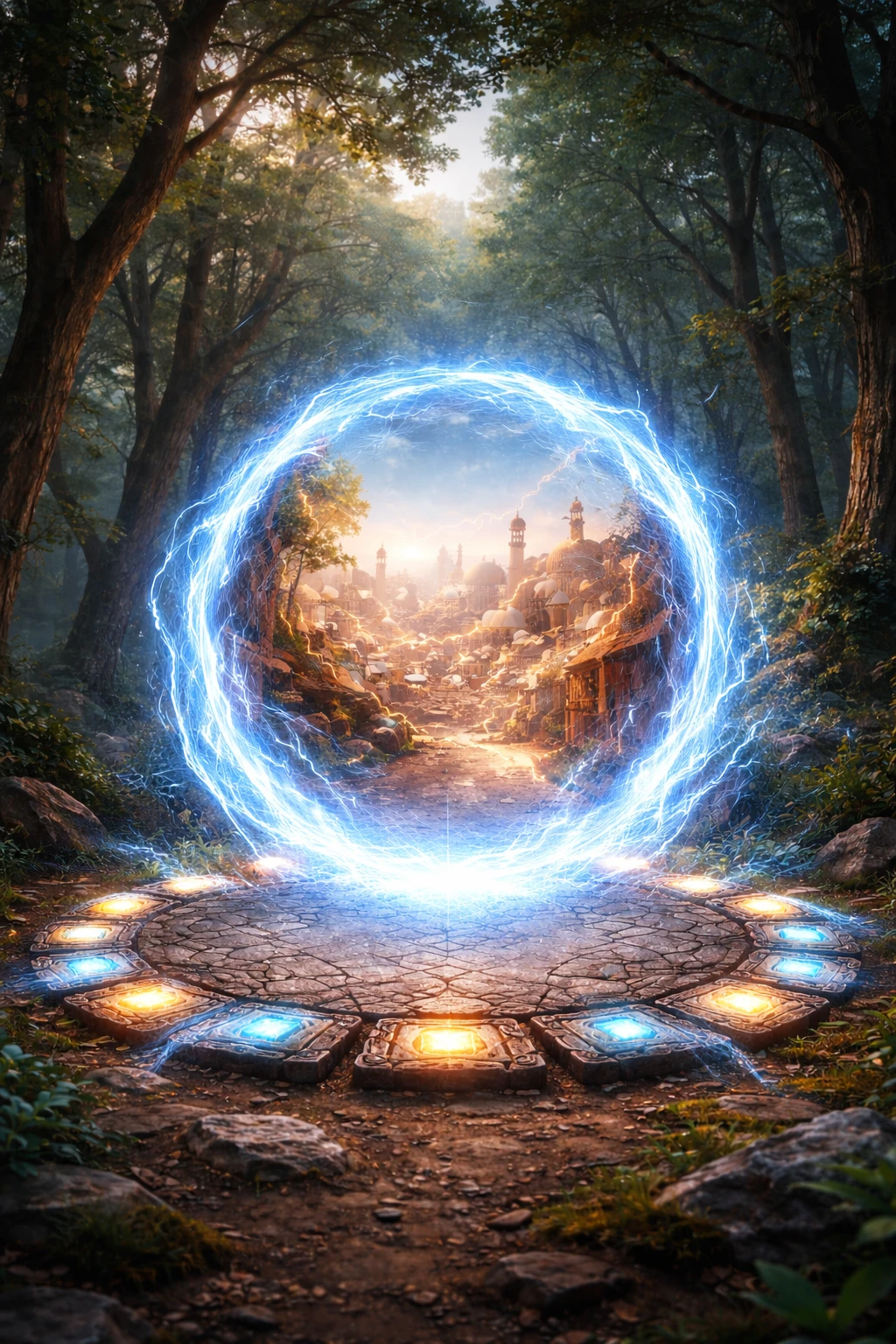
- Constructed with stone or metal runestones.
- May incorporate rotating rings or insertable rune tiles.
- Often integrated into civic infrastructure or arcane academies.
- Provide reliable and repeatable access between established destinations.
Impromptu Portals
In contrast, impromptu portals are temporary constructs created through ritual practice. These are commonly employed by itinerant arcanists or in regions lacking permanent installations.
Characteristics:
- Formed using chalk, ash, or residuum to inscribe the portal circle.
- Require precise geometric and sigilic accuracy.
- More susceptible to instability and misalignment.
- Dependent on the caster’s skill and environmental conditions.
Operation of a Portal
The successful use of a portal follows a standardized procedural sequence:
- Dialing the Sequence
The caster selects and aligns the appropriate runes according to the desired destination and prevailing conditions. - Stabilization of the Gate
Arcane energies converge as the sigilic coordinates resonate, establishing a stable translocative pathway. - Traversal of the Threshold
Once stabilized, the portal manifests as a shimmering aperture through which travelers may safely pass.
Runic Reference
The following table presents the standard Elder Futhark runes as adapted for use within the Runic Portal Network of Zerith. Each rune embodies a conceptual meaning that informs its application within portal sequences.
| Rune | Name | Meaning |
|---|---|---|
| ᚠ | Fehu | Power, nexus |
| ᚢ | Uruz | Mountains, endurance |
| ᚦ | Thurisaz | Barriers, danger |
| ᚨ | Ansuz | Authority, attunement |
| ᚱ | Raido | Travel, pathways |
| ᚲ | Kenaz | Civilization, knowledge |
| ᚷ | Gebo | Connection |
| ᚹ | Wunjo | Safe haven |
| ᚺ | Hagalaz | Instability |
| ᚾ | Nauthiz | Requirement |
| ᛁ | Isa | Stasis |
| ᛃ | Jera | Cycles |
| ᛇ | Eihwaz | Planar boundary |
| ᛈ | Perthro | Secrets |
| ᛉ | Algiz | Protection |
| ᛋ | Sowilo | Radiance |
| ᛏ | Tiwaz | Order |
| ᛒ | Berkano | Nature |
| ᛖ | Ehwaz | Movement |
| ᛗ | Mannaz | Civilization |
| ᛚ | Laguz | Water |
| ᛜ | Ingwaz | Potential |
| ᛞ | Dagaz | Transformation |
| ᛟ | Othala | Ancestral origin |
Concluding Remarks
The Runic Portal Network of Zerith represents one of the most sophisticated achievements of trans-locative magic known to modern scholarship. Its elegant integration of sigilic symbolism, geometric precision, and planar attunement continues to inspire arcane study. Though many of its original creators remain shrouded in mystery, the enduring functionality of these portals stands as a testament to their mastery and provides invaluable infrastructure for the civilizations that now rely upon them.